Recent articles in New York Magazine and other major publications have questioned the value of gifted education, raising concerns about identification, equity, and the effectiveness of gifted programs. These are important concerns, and the gifted education community continues to work toward more equitable and effective approaches. What is often missing from these discussions is educational fit.
Children do not all learn at the same pace or have the same educational needs, and gifted programs are one attempt to improve educational fit for learners whose readiness and learning needs differ significantly from age-based expectations.
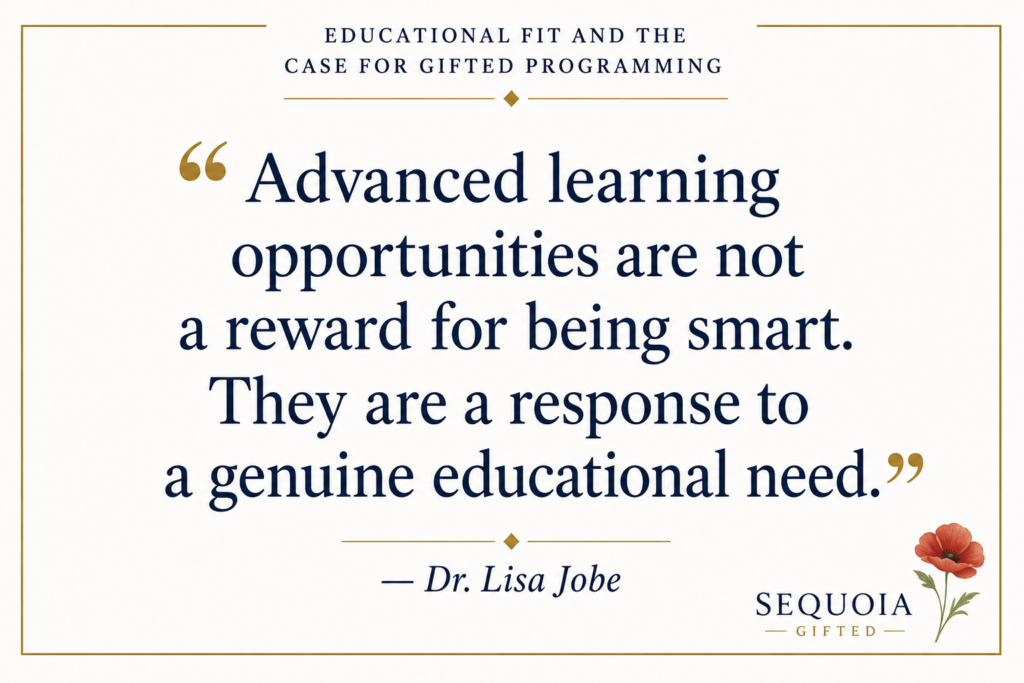
Through my work as an educational specialist and researcher focused on educational fit for profoundly gifted and twice-exceptional learners, I have seen the challenges that arise when educational environments are not aligned with a child’s readiness and learning needs. Advanced learning opportunities are not a reward for being “smart.” They are a response to a genuine educational need. These learners often require substantially different levels of academic challenge, pacing, complexity, and opportunities for advanced reasoning than are typically available in age-based classrooms. Research has consistently documented the consequences of academic mismatch, including underachievement, disengagement, diminished motivation, social-emotional distress, and other negative outcomes when learners are not provided with appropriately challenging instruction.
Educational Fit Beyond Academics
My research builds on others’ findings that educational fit extends beyond academics. Academic, social, emotional, physical and sensory, and creative experiences often interact. A learner may be appropriately placed academically and still experience a significant mismatch in other domains. These patterns are reflected in the Educational Fit Alignment Framework, which examines educational fit across multiple domains rather than focusing solely on academic placement. For example, many gifted learners experience a need for intellectual peer connections and social belonging. They often find friendship, understanding, and acceptance when they are placed with others who share similar interests, humor, intensity, curiosity, and ways of thinking. For some, being among intellectual peers is the first time they feel genuinely understood. Research shows that access to intellectual peers can support academic growth, social development, self-concept, and belonging.
Different Learners, Different Needs
At its core, a free and appropriate public education begins with the recognition that learners have different needs. Public education readily acknowledges that some learners need specialized support. It is often less comfortable acknowledging that other learners may need substantially different levels of challenge, pacing, complexity, and intellectual engagement.
We see this principle throughout education. Students with disabilities may receive specialized services and accommodations. Others pursue career and technical pathways, Advanced Placement courses, dual enrollment opportunities, athletics, music, theater, and other programs designed to meet differing levels of readiness, interest, and need.
The term gifted is imperfect. Yet educators have long recognized that some learners demonstrate educational needs that differ significantly from age-based expectations. Howard Gardner’s work on multiple forms of giftedness further reminds us that exceptional ability can emerge in many domains.
The Role of Gifted Programs
Schools routinely respond to those differences. Students with exceptional musical ability may participate in advanced ensembles that provide greater challenge and opportunities to learn alongside others who share similar strengths. Likewise, varsity athletics provide appropriately challenging environments for students with advanced athletic ability. The benefits extend beyond skill development. These students often find friendship, mentorship, belonging, and community among peers who share their passions and strengths.
Gifted academic programs serve a similar purpose. They provide opportunities for advanced learning, complex reasoning, and engagement with ideas at an appropriate level of challenge. They also provide opportunities to learn alongside peers who share similar curiosity, interests, humor, intensity, and ways of thinking.
When Gifted Programs Are Not Enough
Gifted programming provides an appropriate fit for many learners. Highly gifted, profoundly gifted, and twice-exceptional learners frequently require additional flexibility, acceleration, or individualized pathways. The challenge becomes especially visible among these populations.
One of the thirteen-year-olds I work with takes graduate-level mathematics courses through an Ivy League university while simultaneously studying humanities with age peers. His educational fit reflects different learning environments matched to different needs. Other learners begin taking community college classes at nine or ten years old in areas of strength while participating in different learning environments that better fit other aspects of their development.
I have also worked with many twice-exceptional learners whose extraordinary reasoning abilities were overlooked because disability masked readiness for more advanced learning. In some cases, learners with IQ scores well above 145 have been denied gifted services because advanced reasoning and observable output did not align as expected. My research found that cognitive need for advanced learning and academic production do not always develop in parallel, particularly among twice-exceptional learners.
Educational Fit, Not Future Outcomes
Some critiques of gifted education focus on outcomes, questioning how many identified students ultimately become innovators, scholars, or leaders in their fields. That framing misses the purpose of gifted programming. Gifted programs were never intended to serve as training grounds for Nobel Prize winners, CEOs, professors, or entrepreneurs. Their purpose is to improve educational fit for the learner in front of us.
Few would argue that the value of varsity athletics should be measured solely by the number of students who become professional athletes. Likewise, school theater is not justified only when participants pursue acting careers. These opportunities exist because they provide challenge, growth, engagement, belonging, and educational fit at a particular moment in a student’s development.
Educational decisions are made based on a learner’s needs today. When a child requires substantially different levels of challenge, pacing, or intellectual engagement, the goal is to improve educational fit in the present.
Where Do We Go From Here?
Gifted programs are imperfect and often insufficient. There is still significant work to do, particularly for profoundly gifted and twice-exceptional learners. Eliminating efforts to recognize and respond to advanced learning needs moves us farther from educational fit.
Educational fit for learners at the extreme right tail often requires greater flexibility than traditional gifted programming provides. Acceleration, individualized pathways, dual enrollment, mentorships, and other options may be necessary when readiness and learning needs extend well beyond age-based expectations. Just as gifted programming remains essential, continued efforts to strengthen and expand those opportunities remain equally important.
All children deserve an education that is responsive to their learning needs. A deeper understanding of educational fit helps us recognize that children learn differently, develop differently, and may require different educational environments to thrive.