
Doctoral Dissertation – Elmbridge University – 2026
Why do some highly and profoundly gifted learners struggle in school despite extraordinary abilities? Why are some learners overlooked despite clear evidence of heightened intellect? Why do so many families spend years advocating for change in traditional school settings, often leaving them in search of a better educational fit? And… What does educational fit look like when learning is redesigned around the learner?
Drawing on interviews with parents of highly and profoundly gifted learners identified with learning disabilities, this research explores patterns of educational misalignment, barriers to recognition and response, family advocacy, school withdrawal, and educational realignment designed through “positive niche construction.”
Educational misalignment among highly and profoundly gifted twice-exceptional (HG/PG-2e) learners remains underexamined in educational research. This qualitative multiple case study examined the educational experiences of HG/PG-2e learners across public school and homeschool settings through the Five Environments for Growth: academic/cognitive, social, emotional, physical/sensory, and creative (Baum & Schader, 2024). The study explored educational fit, parent advocacy, school withdrawal, and educational realignment across settings.
Findings revealed recurring patterns of multidimensional educational misalignment despite clear evidence of advanced cognitive ability. Participants described academic underchallenge, constrained expression of ability, social isolation, emotional dysregulation, physical and sensory mismatch, limited opportunities for creative expression, uneven recognition of strengths and disabilities, and prolonged parent advocacy. Four integrated findings emerged: (a) educational fit functioned as a dynamic interaction across environments; (b) ideation production bottlenecks obscured learner capacity; (c) parent advocacy, parallel learning, and school withdrawal emerged in response to mismatch; and (d) homeschooling frequently functioned as a process of educational realignment through reconstructed learning environments.
The study introduces the Educational Fit Alignment Framework, illustrating how misalignment across interconnected environments may constrain learner expression and how environmental realignment may support improved educational fit. Findings suggest implications beyond homeschooling, highlighting the importance of flexibility and multidimensional alignment in supporting HG/PG-2e learners across educational settings.
The Educational Fit Alignment Framework (Jobe, 2026) provides a lens for understanding educational fit for asynchronous learners. Building on Baum & Schader’s (2024) Five Environments for Growth, this framework examines the alignment between the learner and five interconnected environments: academic/cognitive, social, emotional, physical/sensory, and creative.
This framework suggests that educational fit is not determined by class or program placement alone. Rather, educational fit reflects the degree of alignment between the learner and these environments that shape their daily educational experiences. When significant misalignment exists in one or more environment, learners may experience diminished engagement motivation, well-being, or functioning. When environments are intentionally realigned to better match the learner’s strengths, interests, needs, and talent development, educational fit improves and growth becomes more sustainable.
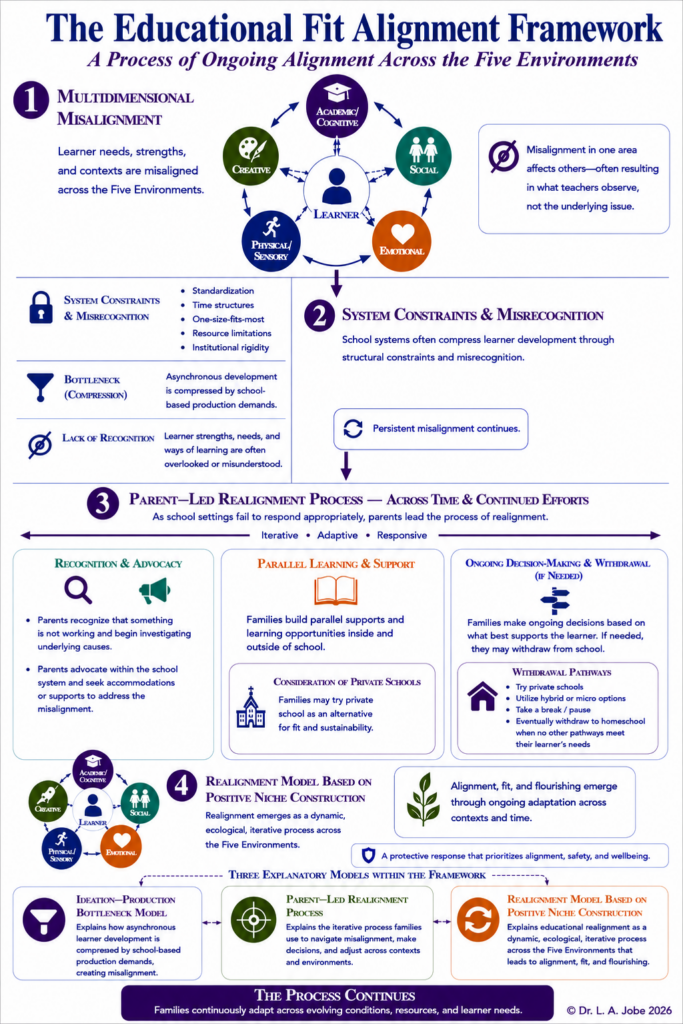
Three additional models emerged from the findings and provide further insight into educational misalignment, family advocacy, and educational realignment.
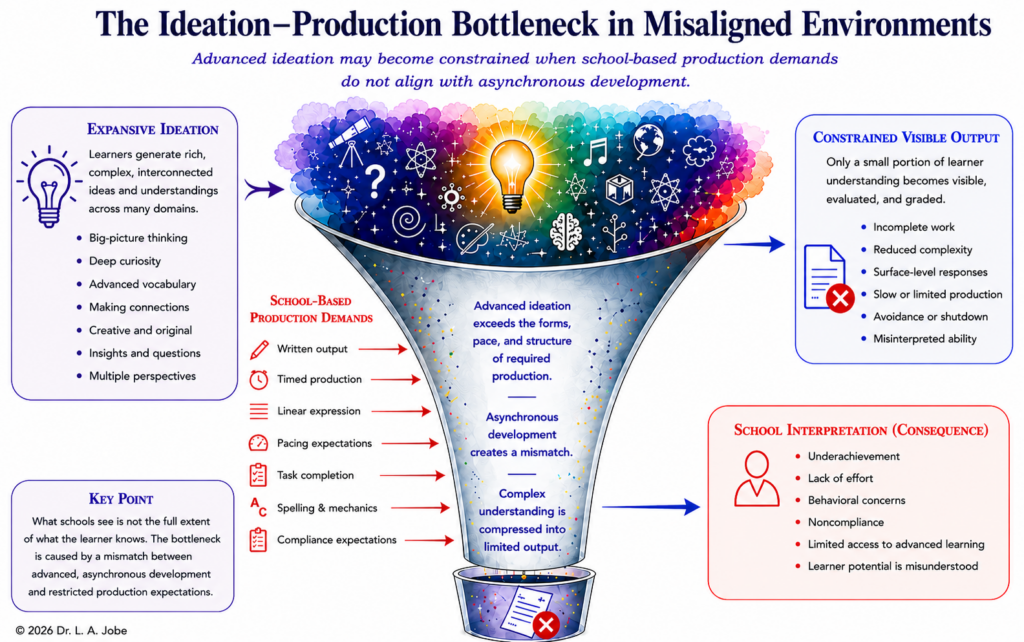
The Ideation-Production Bottleneck Model illustrates how advanced reasoning, complex thinking, and creativity may not always be reflected through traditional measures of performance. This model examines how a gap can develop between what a learner and what schools are able to observe through written work, classroom assignments, and other required forms of production.
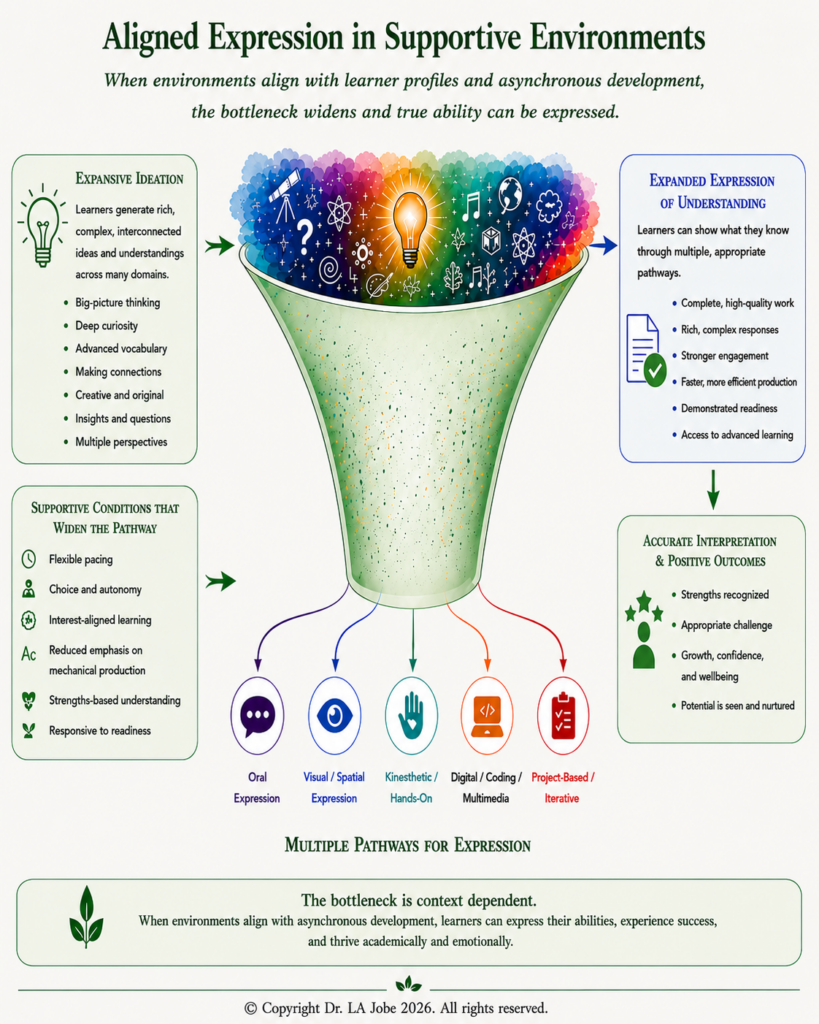
Among the learners in this study, this bottleneck became less restrictive when they had more choice, autonomy, and multiple pathways for expression. The bottleneck, along with executive function factors, appeared more context-dependent, as well. Many learners who had struggled with grades and homework assignments then engaged in college-level coursework, original research, scientific awards and publication, patent writing, professional presentations, advanced musical and other artistic studies, entrepreneurship, and other forms of meaningful, high-level work that had not always been visible in previous educational settings.
The second model to emerge is the Parent-Led Educational Realignment Process. This model illustrates the pathway many families described as they worked to improve educational fit for their children. The process often began with growing school concerns, followed by school advocacy efforts, attempts to create change within existing school settings, efforts to provide better-aligned learning opportunities beyond the school day, and, in most cases, ultimately withdrawing from the school to pursue alternative pathways. This model highlights the role families played in recognizing educational misalignment, attempting to make schools better fit, and seeking more responsive learning to their children’s needs. It also highlighted that in this study, none of the families considered homeschooling as a preferred school choice until other educational options were found to be misaligned with their learners’ needs.

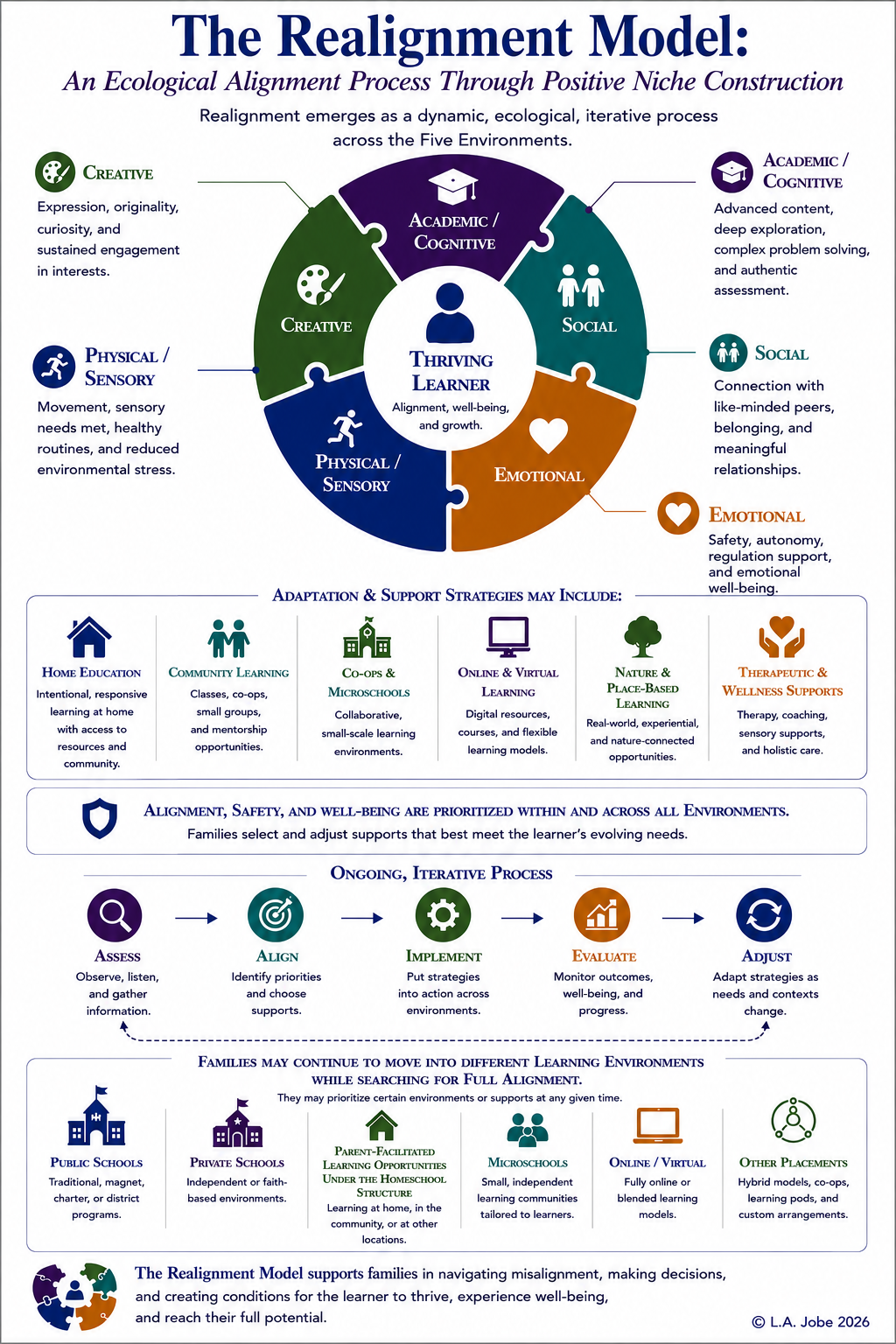
Finally, the Educational Realignment Model illustrates how educational fit is improved when learning environments become more responsive to learner needs across the academic/cognitive, social, emotional, physical/sensory, and creative environments. Grounded in Armstrong’s (2025) concept of Positive Niche Construction, the model highlights how families often build individualized pathways through flexible combinations of significantly advanced coursework, mentorships, creative opportunities, intellectual peer connections, independent study, and other experiences aligned with the learner’s profile. While these examples were most visible in the flexibility of homeschool contexts, this model suggests broader possibilities for creating more responsive learning environments across educational settings.
For parents, educators, and researchers interested in the full study, the complete dissertation is available below.
Download Dissertation (PDF)
View Dissertation in ProQuest (pending)
View Presentation Slide Deck
Return to Home Page